Many aspiring music producers delay their journey because they believe they need expensive equipment before they can create professional music.
The truth is that countless successful producers started with modest setups.
A home studio does not need to be expensive to be effective.
What matters most is understanding which investments provide the biggest improvement and avoiding unnecessary purchases.
Start With Your Goals
Before buying equipment, ask yourself what you want to do.
Different goals require different setups.
For example:
- Music production
- Recording vocals
- Mixing and mastering
- Podcast production
- Film scoring
- Content creation
A producer creating beats has different requirements than a singer recording vocals every day.
Understanding your goals helps prevent wasted money.
The Computer Comes First
Your computer is the foundation of the entire studio.
Without a reliable computer, everything else becomes difficult.
You do not need the most expensive machine available.
Focus on:
- Reliable performance
- Sufficient RAM
- SSD storage
- Stable operation
A modest but dependable computer is usually better than constantly chasing the latest hardware.
Choose the Right DAW
A Digital Audio Workstation (DAW) is where most of your work will happen.
Popular options include:
- FL Studio
- Reaper
- Cubase
- Logic Pro
- Ableton Live
- Studio One
The best DAW is usually the one you learn deeply.
Many professionals create excellent music using different software.
Your skills matter more than the logo on the screen.
Buy an Audio Interface
An audio interface improves recording quality and allows you to connect microphones and monitors.
For beginners, focus on:
- Reliable drivers
- Clean preamps
- Low latency
- Enough inputs for your needs
A good entry-level interface can serve you for years.
Get Decent Headphones
Headphones are often one of the smartest early investments.
They allow you to:
- Produce music
- Edit audio
- Practice mixing
- Work quietly
A reliable pair of studio headphones can often provide more value than cheap monitors in an untreated room.
Do Not Rush to Buy Studio Monitors
Many beginners purchase monitors before understanding room acoustics.
Unfortunately, monitors only perform as well as the room allows.
In a poor acoustic environment, expensive monitors may still produce misleading results.
If your budget is limited, quality headphones can often be a better first purchase.
The Microphone Question
Not everyone needs a microphone immediately.
If you primarily create instrumental music, a microphone may not be essential.
However, if you plan to record:
- Vocals
- Podcasts
- Voiceovers
- Acoustic instruments
A good microphone becomes important.
Choose a microphone that matches your recording environment and goals.
Acoustic Treatment Is Often Overlooked
Many producers spend hundreds of dollars on plugins while ignoring their room.
Acoustic treatment helps improve monitoring accuracy.
Basic treatment may include:
- Acoustic panels
- Bass traps
- Better speaker placement
- Reflection control
Even small improvements can make a noticeable difference.
Avoid Gear Acquisition Syndrome
One of the biggest mistakes beginners make is constantly buying equipment.
This habit is often called Gear Acquisition Syndrome (GAS).
Symptoms include:
- Buying plugins instead of practicing
- Upgrading equipment too frequently
- Believing gear will solve skill problems
Equipment matters, but experience matters more.
Many great records were created with surprisingly simple setups.
Focus on Learning
The fastest way to improve is not always through purchases.
Instead, invest time in:
- Music theory
- Production techniques
- Mixing fundamentals
- Critical listening
- Finishing projects
Knowledge often provides a greater return than new gear.
Example Budget Studio Setup
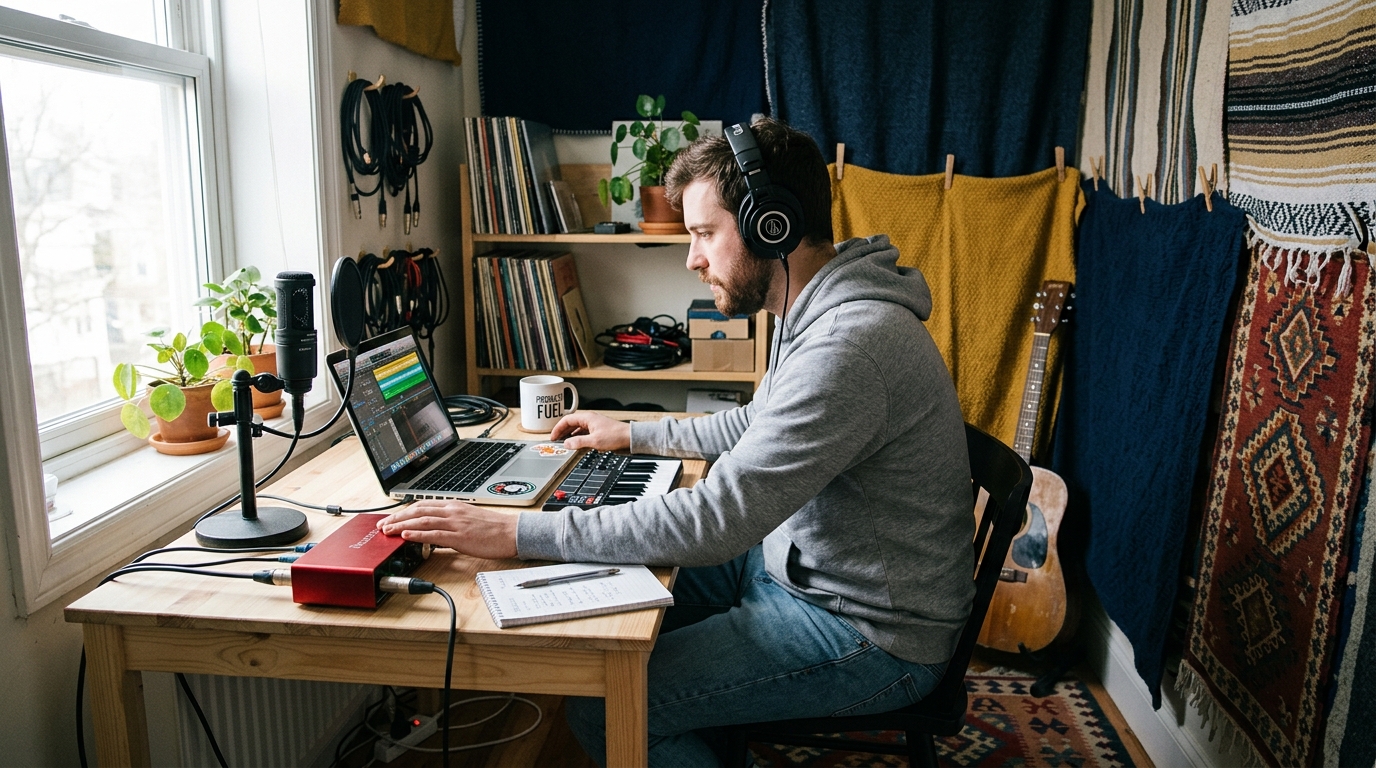
A practical beginner setup might include:
- Computer
- DAW
- Audio interface
- Studio headphones
- Basic microphone
- MIDI keyboard (optional)
This is enough to produce, record, and release music.
Many successful producers started with even less.
Upgrade in Stages
Instead of buying everything at once, upgrade gradually.
A common upgrade path looks like:
- Computer
- DAW
- Audio interface
- Headphones
- Microphone
- Studio monitors
- Acoustic treatment
This approach reduces waste and helps you understand what actually improves your workflow.
The Reality
A professional studio is built over time.
Most producers do not start with premium equipment.
They start with what they have available and improve their setup as their skills and income grow.
Consistency is more important than perfection.
Final Thoughts
Building a home studio on a budget is completely possible.
Focus on the essentials, avoid unnecessary purchases, and prioritize learning over gear.
A simple setup in the hands of a skilled producer can achieve remarkable results.
The goal is not to own every piece of equipment.
The goal is to create music, improve your skills, and build a studio that supports your creative process.