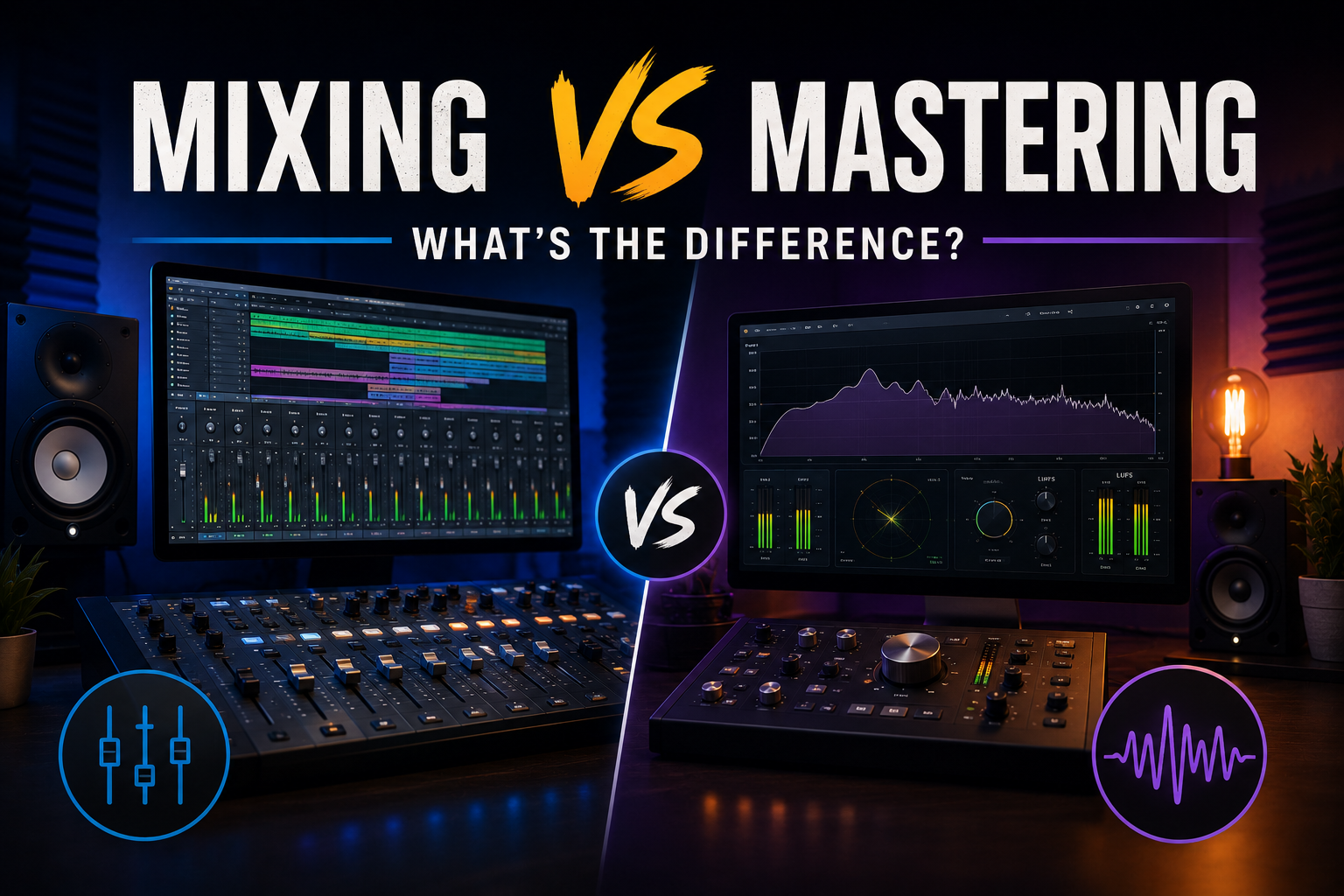
Many beginners use the terms “mixing” and “mastering” interchangeably.
However, they are two completely different stages of the music production process.
Understanding the difference is important because each stage has a unique purpose and requires a different mindset.
What Is Mixing?
Mixing is the process of combining all the individual elements of a song into a balanced and cohesive final mix.
A mix engineer works with separate tracks such as:
- Vocals
- Drums
- Bass
- Guitars
- Keyboards
- Synths
- Effects
The goal is to make all these elements work together.
What Happens During Mixing?
A mix engineer may perform tasks such as:
- Volume balancing
- Panning
- EQ
- Compression
- Reverb
- Delay
- Saturation
- Automation
- Noise reduction
These tools help create clarity, depth, impact, and emotion within a song.
Mixing focuses on the relationship between individual elements.
What Is Mastering?
Mastering is the final stage of audio production.
Unlike mixing, mastering usually works with a single stereo file rather than individual tracks.
The purpose of mastering is to prepare a song for release.
A mastering engineer focuses on the overall sound of the finished mix.
What Happens During Mastering?
Common mastering tasks include:
- Final EQ adjustments
- Dynamic control
- Stereo enhancement
- Loudness optimization
- Limiting
- Quality control
- Format preparation
Mastering ensures that the song translates well across different playback systems.
A Simple Analogy
Imagine making a movie.
Mixing Is Like Editing Individual Scenes
You adjust:
- Dialogue levels
- Sound effects
- Music balance
- Scene transitions
Everything is shaped to work together.
Mastering Is Like Preparing the Final Movie Release
Once the movie is complete, it is optimized and prepared for cinemas, streaming platforms, and distribution.
The same concept applies to music.
Can Mastering Fix a Bad Mix?
This is one of the biggest misconceptions in music production.
Mastering cannot magically repair a poor mix.
If the vocal is too loud, the kick is weak, or the instruments are fighting each other, these problems should be solved during mixing.
Mastering works best when the mix is already strong.
Why Mixing Matters More
Many producers obsess over mastering while neglecting mixing.
In reality, the quality of the final result is heavily influenced by the mix itself.
A great mix often requires only subtle mastering.
A poor mix remains a poor mix even after professional mastering.
This is why experienced engineers often say:
You cannot master your way out of a bad mix.
Should You Learn Mixing or Mastering First?
For beginners, mixing should be the priority.
Mixing teaches:
- Balance
- Frequency management
- Dynamics
- Spatial effects
- Critical listening
These skills form the foundation of audio engineering.
Mastering becomes easier when you already understand mixing.
Can One Person Do Both?
Yes.
Many independent producers mix and master their own music.
However, there is a challenge.
After spending hours mixing a track, it can be difficult to remain objective during mastering.
This is why professional projects often use separate mixing and mastering engineers.
Fresh ears can identify problems more easily.
Common Beginner Mistakes
Many producers:
- Put limiters on every track
- Focus on loudness before balance
- Use mastering plugins during production
- Ignore mix problems and hope mastering will fix them
These habits often lead to worse results.
A strong mix should always come before mastering.
The Reality
Mixing and mastering are not competing processes.
They are complementary stages of the same workflow.
Mixing creates the song.
Mastering prepares the song for the world.
Both are important, but they serve different purposes.
Final Thoughts
Mixing and mastering are often confused, but they solve different problems.
Mixing focuses on balancing and shaping individual elements within a song.
Mastering focuses on enhancing and preparing the completed mix for release.
If you are a beginner, spend most of your time improving your mixing skills.
A strong mix is the foundation of every great master.