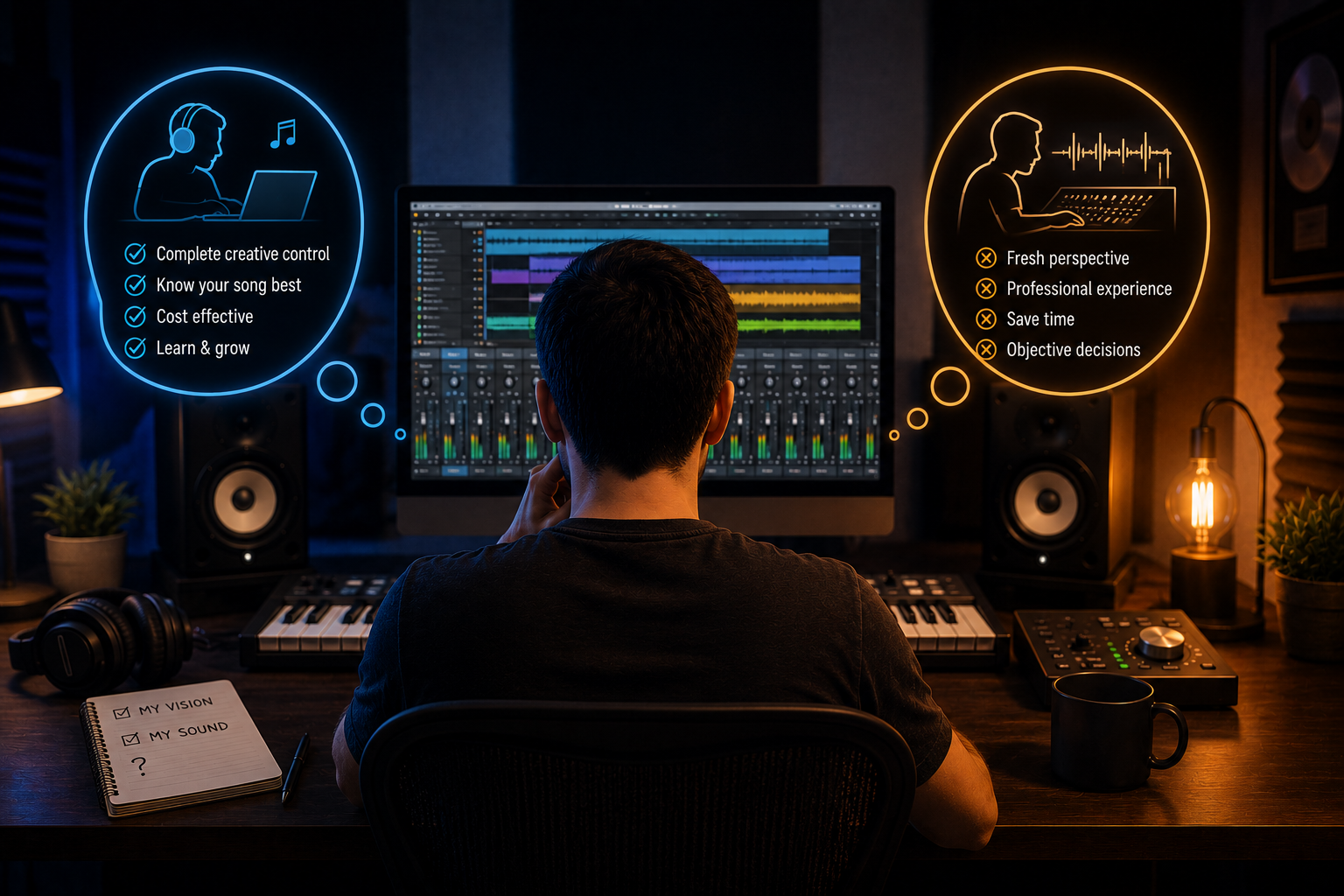
One of the most common questions producers ask is whether they should mix their own music or hire a professional mix engineer.
The answer depends on your goals, budget, experience, and stage of your career.
There is no single solution that works for everyone.
Why Many Producers Mix Their Own Music
Most producers start by mixing their own tracks.
There are several reasons for this.
First, hiring a professional mix engineer can be expensive.
Second, mixing your own music helps you develop a deeper understanding of production, arrangement, and sound design.
When you learn to mix, you begin hearing problems that you may have ignored during production.
This often leads to better songwriting and production decisions.
The Advantages of Mixing Your Own Music
You Save Money
For independent artists and producers, budget is often limited.
Mixing your own music allows you to release more music without paying for professional mixing services.
You Learn Faster
Every mix teaches valuable lessons.
You learn:
- Balance
- EQ
- Compression
- Automation
- Stereo imaging
- Critical listening
The more projects you finish, the faster you improve.
Complete Creative Control
Some artists prefer making every decision themselves.
Mixing your own music allows you to maintain complete control over the final sound.
You decide how aggressive, bright, warm, or dynamic the mix should be.
The Disadvantages of Mixing Your Own Music
You Lose Objectivity
This is one of the biggest challenges.
After hearing a song hundreds of times during production, it becomes difficult to judge it objectively.
You may overlook problems because your brain has become accustomed to them.
A fresh set of ears often notices issues immediately.
Production and Mixing Require Different Mindsets
Producing and mixing involve different goals.
During production, creativity is the priority.
During mixing, technical decision-making becomes more important.
Switching between these roles can be difficult.
It Takes Time
Learning to mix professionally takes years.
Many producers underestimate the amount of practice required to develop reliable mixing skills.
When Hiring a Mix Engineer Makes Sense
There are situations where hiring a professional can be a smart investment.
Examples include:
- Important commercial releases
- Label projects
- Film and television work
- Competitive music markets
- Projects with larger budgets
A professional mix engineer brings experience, objectivity, and efficiency.
The Hybrid Approach
Many successful producers use a hybrid approach.
They create a rough mix themselves and then hire a professional mix engineer for the final version.
This allows them to maintain creative control while benefiting from professional expertise.
It can also become a valuable learning experience.
Questions to Ask Yourself
Before deciding, ask:
- Is this release important?
- Do I have the necessary mixing skills?
- Can I objectively evaluate my music?
- Do I have the budget for professional mixing?
- Am I willing to invest time into learning?
The answers often make the decision much clearer.
The Reality
Many successful producers mix their own music.
Many successful producers also hire mix engineers.
Neither approach is automatically better.
The best choice depends on your goals and circumstances.
A Long-Term Perspective
Even if you plan to hire mix engineers in the future, learning the fundamentals of mixing is extremely valuable.
Better mixing knowledge helps you:
- Produce better tracks
- Communicate with engineers
- Identify problems earlier
- Improve your overall musical skills
Mixing knowledge benefits every producer.
Final Thoughts
You should mix your own music if you want to learn, save money, and maintain creative control.
You should consider hiring a professional mix engineer when objectivity, quality, and efficiency become more important than cost.
Ultimately, the goal is not to prove that you can do everything yourself.
The goal is to create the best possible music.
Choose the approach that helps you achieve that goal.